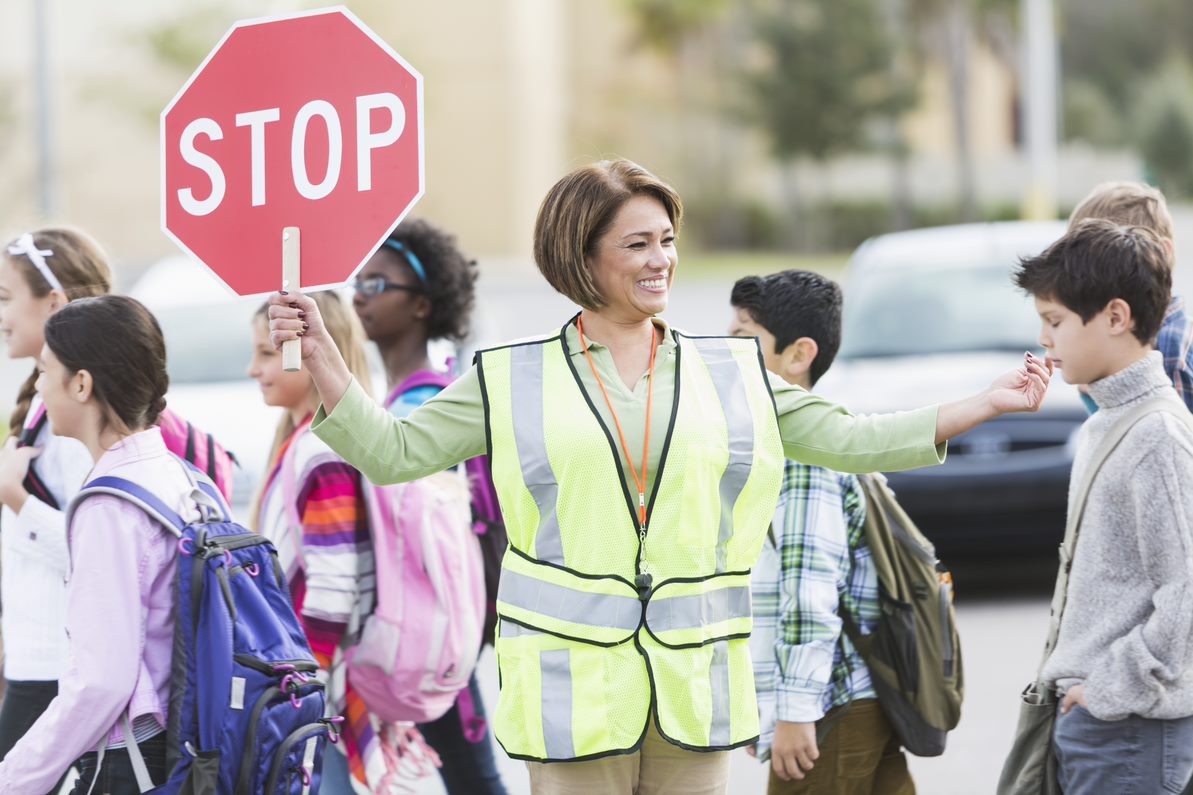
The purpose of this resource is to support the implementation of a school crossing guard, in order to help students and their families safely cross the street on their way to/from school, and remind drivers to watch for pedestrians at crossings.
Description
Having a trained and highly visible person to stop traffic and assist with crossing at busy intersections —in particular, where there is a high potential for conflict with motor vehicles—can improve safety for those who walk and wheel. The actual improvement in physical safety contributes to an increase in perceived safety as well, which is key for encouraging parents to allow their children to use active modes of travel.
A School Crossing Guard is usually a paid position, appointed by the local municipality or police service, depending on the region. The organization that manages the Crossing Guard program determines whether or not a guard is warranted at any particular location, based on a set of standard criteria, such as the speed and volume of vehicles and the number of students using the crossing location.
Parents/caregivers can usually submit a request for a School Crossing Guard, and the local program manager will investigate the safety concerns and assess the proposed location. The request process and the criteria used to determine eligibility vary by region. Search your municipal website, speak to a local government representative (e.g., town clerk, city councillor), or call 311 to find out about the process and criteria in your area. Note that some regions only review applications at certain times of the year.
Often, Crossing Guards can only be assigned where there is already a marked crossing in place. If there is a location where many students regularly cross without a marked crossing (e.g., a popular shortcut that crosses a street), it is recommended to first look into the local process to request or improve a crossing.
What you will need
- Input from members of your school community
- Information about the process/criteria for a crossing guard request in your region
Who can help
Parents/caregivers, students, school staff, local elected officials such as municipal councillors or school board trustees, and other community residents.
Resources
The Adult School Crossing Guard Guidelines, available in the Safe Routes to School Online Guide, provides resources to help you develop a program.
Key words
Request, crossing, guard, intersection, application, walk, route, road safety.