
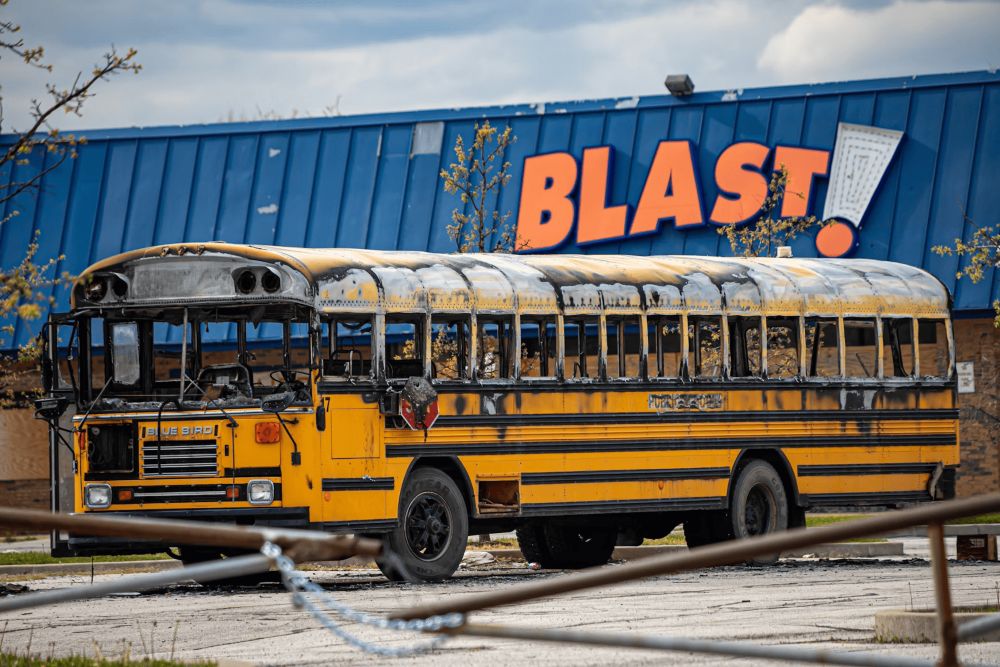
Electric school buses (ESBs) are gaining momentum across North America for their environmental and health benefits. However, recent fire incidents have sparked public concern and misinformation about their safety.
Let’s address some of the most common myths surrounding ESB fires and set the record straight.
Common Myths About ESB Fires
Despite strong safety records, several misconceptions continue to circulate:
- “Electric school buses are more prone to fires than diesel buses.”
- “Lithium-ion batteries are unstable and can explode at any moment.”
- “Recent ESB fire incidents prove these vehicles are unsafe.”
These claims are not supported by data or expert analysis. Yet they persist, often fueled by social media comments. So, what’s really going on?
Understanding ESB Fires
ESBs use the same core technology as electric transit buses and passenger electric vehicles (EVs): lithium-ion batteries, electric drivetrains, and battery management systems. That means we can reliably use data from these vehicles to understand ESB fire risks.
Since 2010, there have been 27 verified battery fires involving electric buses worldwide, out of more than 250,000 electric buses in operation. These fires resulted in nine injuries and zero fatalities. Here’s a breakdown:
- 12 fires occurred in depots
- 1 in a maintenance workshop
- 7 while charging
- 7 involved multiple buses due fire spread
- 1 involved a vapor cloud explosion
Electric vs. Thermal Bus Fires
Fires in ESBs are exceptional, but they can behave differently from fires in internal combustion engine (ICE) buses. Lithium-ion battery fires may require more water or special cooling to control, especially in older battery types. Modern ESBs use safer lithium-iron-phosphate batteries, which emit fewer toxic gases like carbon monoxide, but can still release hazardous substances such as hydrogen fluoride.
While ESB fire incidents deserve attention, they are rare, especially when compared to fire incidents involving ICE buses, including gas, diesel, and propane models.
Safer Than You Think
ESBs are less likely to catch fire than their ICE counterparts, and that’s no accident. Their design, materials, and safety systems all contribute to a much lower fire risk.
Reason #1: No Flammable Liquids or Gases
One of the biggest safety advantages of ESBs is what they don’t have: flammable fuels. Unlike ICE buses, ESBs eliminate the risk of fires caused by gasoline, diesel, or propane substances responsible for two-thirds of vehicle fire fatalities (1).
Reason #2: Rigorous Battery Testing
ESB batteries undergo extensive testing to meet global safety standards: SAE J2929 for battery safety, ISO 26262 for monitoring systems, and UL and UN certifications for commercial sale (2). These standards ensure a high degree of safety and reliability. Battery failure rates are estimated at 1 in 40 million, making fire less likely than being struck by lightning (3).
Reason #3: Smart Battery Placement
ESB batteries are housed in a weatherproof metal casing, between chassis guard rails, and positioned away from passengers (4). This protects the batteries from collisions, theft, and environmentla damage. It also lowers the vehicle’s centre of gravity, making ESBs less prone to rollovers. Rollovers cause a third of passenger fatalities in school bus crashes (5).
Reason #4: Built-in Fire Prevention
ESBs are equipped with multiple layers of electrical safety: automatic disconnects that cut power during crashes or short circuits; manual cutoff switches as a backup; and battery management systems that monitor temperature in real time. These systems work together to prevent overheating and electrical faults.
Reason #5: Safer Battery Chemistry
Most ESBs use lithium-iron-phosphate batteries, which are more thermally stable than the nickel-manganese-cobalt batteries used in many EVs (6); better at maintaining integrity under high temperatures; and less likely to experience thermal runaway. They also include Passive Propagation Resistance, which isolates thermal issues in individual cells and vents heat safely, preventing fires from spreading.
Conclusion: Myth Busted
Every school bus fire–whether electric or diesel–deserves attention. But the facts are clear:
- ESBs are far less likely to catch fire than ICE buses.
- ESBs eliminate the most dangerous fire risks.
- ESBs are built with multiple layers of safety.
Spreading fear based on isolated incidents doesn’t make students safer—it only slows down progress. Instead, let’s focus on what the evidence shows and support the transition to cleaner and safer school transportation for the health and future of our children.
(1) National Fire Protection Association (NFPA). (2024, November). Vehicles fires.
(2) Electric School Bus Initiative. (2023, September). All About Electric School Bus Battery Safety.
(3) The Faraday Institution. (2023, July). Improving the Safety of Lithium-ion Battery Cells. Faraday Insights, 17.
(4) Bisschop, R., Willstrand, O. and Rosengren, M. (2020, September). Handling Lithium-Ion Batteries in Electric Vehicles: Preventing and Recovering from Hazardous Events. Fire Technology, 56, 2671-2694.
(5) National Fire Protection Association (NFPA). (2024, November). Vehicles fires.
(6) Golubkov, A. et al. (2014). Thermal-runaway experiments on consumer Li-ion batteries with metal-oxide and olivin-type cathodes. RSC Advances, 4, 3633-3642.