
It’s no secret that working conditions in the school transportation sector have long needed improvement. In provinces like Quebec and Ontario, this is reflected in more frequent labour disputes and service disruptions. Let’s face it: the working conditions in the sector make it difficult to attract and retain workers. Hours are irregular and often part-time, wages are not competitive, benefits are limited, and there’s the added challenge of supervising children.
Given this precarious context, can the electrification of school transportation help improve the sector’s standing?
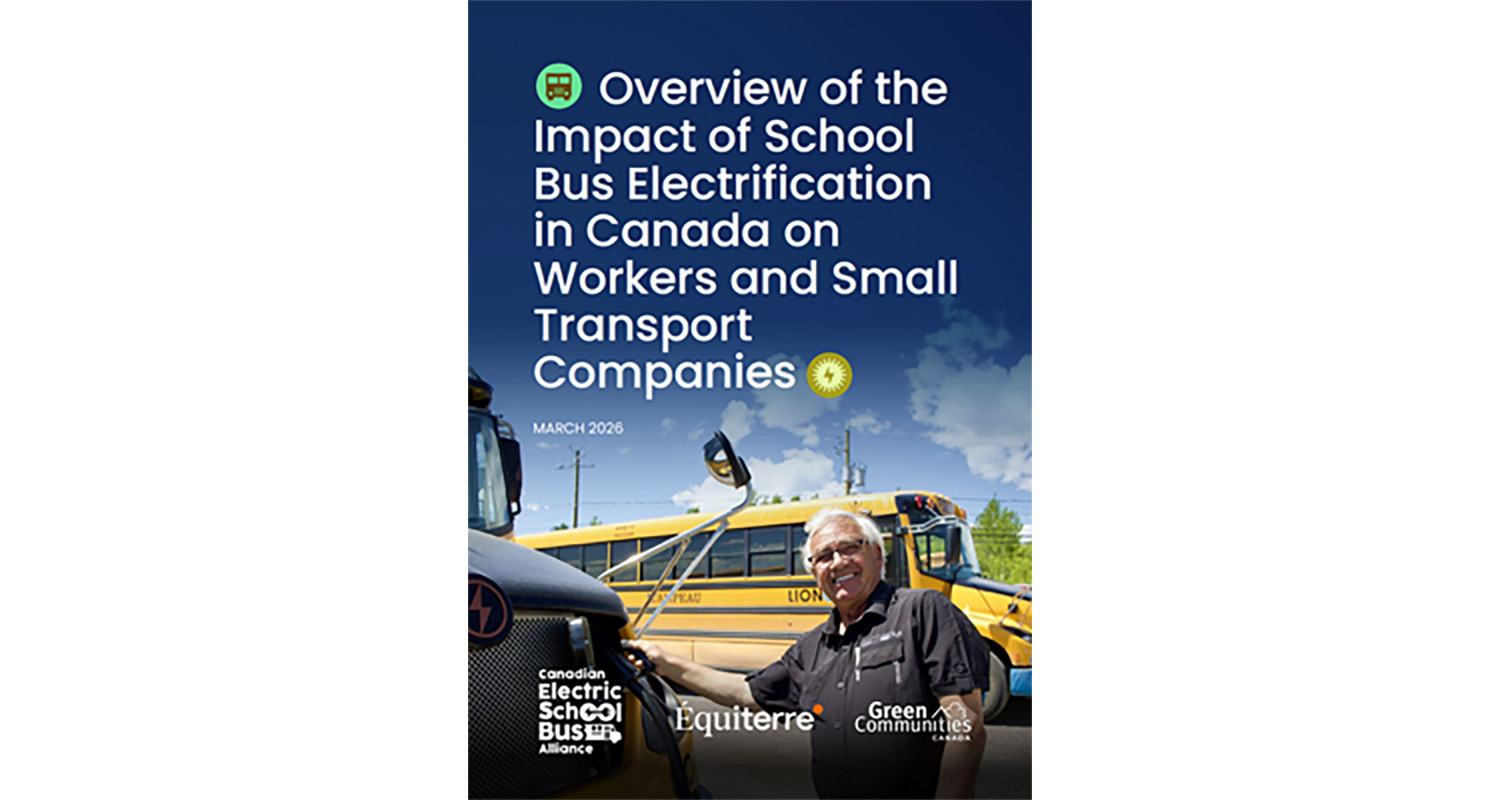
Driving an electric or diesel school bus doesn’t significantly change working conditions.1 However, our latest report, Overview of the Impact of School Bus Electrification in Canada on Workers and Small Transport Companies, highlights the sector’s shortcomings and demonstrates how funding for electrification can allow governments to take a different approach.
1. Disparities between the private and public sectors
Did you know that, nationwide, less than half of all school buses are run by school boards or provincial governments?2 If you live in Quebec or Ontario, there’s a 90 per cent chance that your child’s school transportation is operated by a private company. Private operators play a central role in delivering this essential service, often in a challenging business context characterized by tight margins, seasonal work, and rising costs. These structural constraints can limit their ability to offer stable, competitive working conditions. As a result, provinces where school transportation is primarily provided by the public sector generally tend to offer stronger wages, benefits, and job stability.
In Ontario, which is almost entirely privately operated, the average hourly wage of unionized drivers is $20.94, the lowest in the country. In Quebec, a private-sector driver earns an average of $21.85 per hour, with no pension plan or insurance, compared to $23.47 per hour in the public sector with benefits. In Nova Scotia, private-sector workers earn an average of 18.7 per cent less than their public-sector counterparts.
These discrepancies affect the quality of operations. In Quebec, 65 per cent of school transportation service disruptions are attributable to labour issues or disputes. In contrast, a pilot project, in which a Quebec school board took over transportation operations, reduced service disruptions by 95 per cent in one year.
- What governments can do: support the scaling and adaptation of more stable bus service delivery models, including increased public operation, where appropriate
2. Inequalities between small and large private operators
Workers in small private companies face compounded disadvantages: compared to the public sector, conditions are generally weaker, while they also face competition from larger companies.
In Quebec, the ten largest school bus operators now hold a market share of 40 per cent, up from 35 per cent in 2011. Since 2021, 95 small operators have gone out of business, mainly due to takeovers by larger companies. Today, nearly 23 per cent of small carriers face an imminent risk of being sold.
Electrification can exacerbate these inequalities if it is not paired with targeted support. Small operators, who play a crucial role in rural areas, often have less access to capital and internal resources to manage the transition. This makes it more difficult to absorb the higher upfront costs of electric school buses, and invest in charging infrastructure, training, and operational adjustments.
- What governments can do: offer a tax credit to small school bus operators who electrify their bus fleets.
3. A lack of training
The transition highlights another challenge: workforce training. Despite the presence of more than 1,600 electric school buses in Quebec, mandatory training for driving has been limited since 2024 to a 90-second video. In Ontario, Alberta, and New Brunswick, no specific training on electric school buses has been added to existing programs. Prince Edward Island leads the country in its transition to electric school buses and has trained all its drivers to operate these buses.
The lack of training is also noticeable in the mechanical sector. In Quebec, there are only two public training programs for heavy-duty electric vehicles. However, many challenges remain, such as the high cost of training equipment, the difficulty of freeing staff during a labour shortage, and, above all, manufacturers limiting access to repair manuals.
- What governments can do: incorporate content on driving electric buses into mandatory training programs, and condition funding on greater access to technical data from manufacturers.
4. A lever for improving workforce conditions
These findings demonstrate that electrification of school transportation can simultaneously address the challenges of market consolidation, inequities among organizational models, and skills shortages. But electrifying school transportation can only do these things if it is better funded and planned. By including training, maintenance, and support for small carriers in funding programs, governments can make the sector more attractive, stable, and efficient, while increasing the return on investment of public funds.
The potential renewal of federal funding presents a strategic opportunity. The Canadian Electric School Bus Alliance recommends a $250 million federal investment under the new Canada Public Transit Fund. This funding would not only encourage the purchase of new electric school buses but also ensure proper operation and maintenance of current buses through a more sustainable workforce.
1 – It should be noted, however, that drivers have reported specific challenges related to electric buses, such as range and charging management.
2 – Given that Quebec (10,650 school buses) and Ontario (20,833 school buses) represent over 50% of Canada’s school bus fleet (51,000 school buses) and are both over 90% privately owned, we could be looking at a 60-40 split in favor of private ownership. It’s worth noting that most provinces, however, operate exclusively public fleets (BC, Manitoba, NB, NS, PEI).