We’ve got a problem. Our school zones aren’t what they should be. 9 out of 10 parents witness dangerous driving in school zones. School staff in Ontario spend over 700,000 hours per year dealing with traffic issues! Less than 25 per cent of kids use active modes of transportation and less than 1 in 10 kids are getting their daily recommended physical activity.
It’s time to intervene, and that’s what the National Active School Streets Initiative (aka “School Streets”) has been doing across Canada. School Streets creates car-free zones in front of schools. These car-free zones help increase rates of physical activity, create safer spaces for children to travel to and from school, improve air quality, and foster community connections.
This Voices for Action panel brought together people who have been leading School Streets in communities based in B.C., Ontario, and Quebec. Hear first-hand how these implementations have provided solutions and improved community happiness and health.
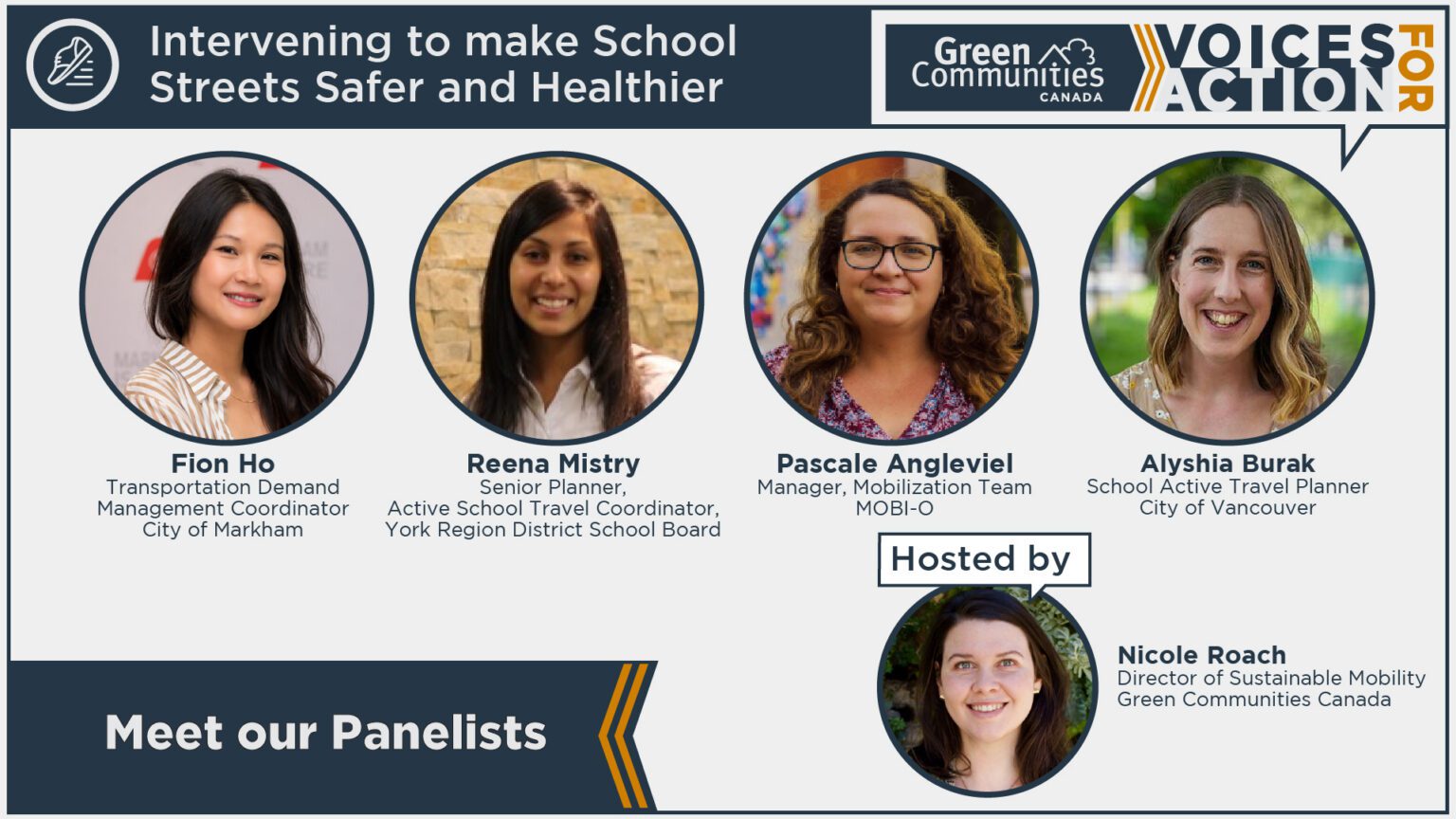
Meet the Panelists:
Pascale Angleviel (elle)
Pascale joined MOBI-O in 2024 to develop and implement initiatives that promote sustainable mobility. (MOBI-O = Centre d’expertise en mobilité de l’Outaouais et de l’Abitibi-Témiscamingue.)
Drawing on several years of experience managing environmental projects for non-profit organizations and local communities, Pascale now leads MOBI-O’s Mobilisation team.
The Mobilisation team designs and delivers projects that promote active transportation and sustainable mobility for businesses, municipalities, and schools. The team coordinates the “Going to School on foot or by bike… I Can Do It!“ campaign, which supports schools in implementing initiatives that encourage safer and more active travel. Since 2023, the campaign has also expanded to include the implementation of School Streets in Gatineau, helping create safer, more welcoming environments that encourage children to walk and cycle to school.
Alyshia Burak (she/her)
Alyshia Burak is a School Active Travel Planner with the City of Vancouver, bringing more than a decade of experience advancing sustainable transportation initiatives that help families walk, bike, and roll to school. She leads Vancouver’s participation in the National Active School Streets Initiative and has delivered School Streets at 14 schools since the City’s program launched in 2021. As a mom of two, Alyshia is often found riding around the city on her family’s bright yellow cargo bike, sharing the freedom and joy of cycling with her kids.
Fion Ho (she/her)
Fion Ho is the Transportation Demand Management (TDM) Coordinator at the City of Markham, with over 14 years of municipal experience in active transportation. She has managed a range projects, including Markham’s Active Transportation Master Plan, the Markham Cycles Bike Hub Program, Markham Cycling Day, and the Active School Travel Program. Fion is currently involved in the School Streets Project, delivered in partnership with the York Region District School Board, to help create safer and more welcoming environments around schools.
Reena Mistry (she/her)
Reena Mistry is a Senior Planner, Active School Travel Coordinator with the York Region District School Board. In this role she collaborates with school communities and a broad range of stakeholders to build capacity for active school travel initiatives and enhance school zone safety. Reena has successfully led and implemented several pilot programs designed to advance active transportation and foster sustainable travel habits among students and families. She is passionate about developing innovative strategies that encourage active lifestyles while supporting healthier, safer, and more connected school communities. Reena brings more than 8 years of experience in school travel planning.
Resources and Links shared during the Panel:
- GCC’s Sustainable Mobility program.
- GCC’s School Streets program.
- School Streets implemented in the 2025/26 school year.
- Job posting: join GCC as a School Travel Planner.
- About MOBI-O.
- Gatineau MOBI-O School Streets.
- “At school on foot or by bike, I am capable!” campaign by MOBI-O.
- Details on MOBI-O’s Rue-école Monseigneur-Charbonneau.
- The City of Markham’s School Streets Initiative 2026.
- City of Markham and York Region District School Board School Streets.
- City of Vancouver’s School Streets initiatives.
- A volunteer’s guide to setting up a School Street video by the City of Vancouver.
- Apply to join GCC’s Community of Practice for the National Active School Streets Initiative.
Questions & Answers
We ran out of time during the event to cover all the questions submitted by attendees. Panelists were kind enough to provide some written responses:
Q1
What about parents with disabilities that drive a wheelchair accessible hybrid vehicle and don’t have time or means to drop off their children without this vehicle?
A1
City of Vancouver: While we promote walking, biking, or rolling to school, we recognize that some families may need to drive. All other blocks around the schools apart from the School Street remain accessible by motor vehicle. Where accessible parking spaces and entrances are impacted by the School Street, we work with the school community to designate additional accessible parking space as needed.
City of Markham/YRDSB: Our goal is to encourage as many families to use active modes as often as possible; however, we understand that this may not be possible for all. Those with accessibility needs or other health conditions are asked to connect with the school directly so we can come up with a plan. In our case the parking lot was accessible. While it was closed off to parents during the pilot, entry was allowed for those with accessibility needs or other needs. If the parking lot was not a practical option, we would allow the driver through the School Streets however they would be asked to drive at walking pace and volunteers/traffic contractor would be guiding them through the closure area.
MOBI-O: Like the City of Vancouver, we also work with the school community to designate additional accessible parking space as needed.
Q2
Is a School Street program just for 5 days, or for the whole school year?
A2
City of Vancouver: There are a variety of different types of School Street programs. At some sites they run for a short duration (e.g. one week), while at other sites they run for the whole school year. The length of program often depends on the level of resources and support available.
City of Markham/YRDSB: This Spring in Markham, Ontario, the program was a month long. In the past, we had piloted the program once a week. There are different types of programs and that would guide their length.
MOBI-O: You can also do the School Street for fewer than five days. In our case, we have also implemented one-day School Streets once a month. There’s no set rule, especially for a first trial. The most important thing is to communicate it well.
Q3
Was driveway access for residents along the permanent closure an issue?
A3
City of Vancouver: In the City of Vancouver we prioritize streets without driveways and where residents have alternative access to their homes through alleys. We occasionally receive a request for a resident parked on the block to exit the closure. Staff and volunteers on site are trained on how to safely escort vehicles out of the closure if needed.
City of Markham/YRDSB: There were no driveways impacted for this pilot.
Centre d’écologie urbaine (NASSI technical lead): In Quebec, in the vast majority of cases, the only people allowed to drive on a School Street (except for emergency services and school buses in certain cases) were residents. However, they were always escorted by staff or volunteers. This could be a source of frustration for some residents, but street closures usually only add around 1 to 2 minutes to the school commute.
Q4
With a diverse community such as Markham, did the team consider translating materials or cultural norms around mobility?
A4
City of Markham/YRDSB: We follow the protocol of the school’s admin. If the school’s admin is currently having their communication to families translated, we would also do so; however, if the school’s admin is not, we do not.
Q5
What activities can be done on a public road which cannot be done on the school playgrounds?
A5
City of Vancouver: While School Streets is not intended to replace natural play spaces like playgrounds or serve as an extension of school facilities, it provides additional space and time for students and families to connect at the start and end of the school day. In doing so, it has fostered stronger community connections and supported safer school access—benefits consistently noted by both parents and students at participating sites.
Centre d’écologie urbaine (NASSI technical lead): Children have the same right to the city and public spaces as adults do. School Streets also meet additional needs that a school playground and/or a park does not:
- It offers children a space and time for free play near the school.
- It makes the area around the school safer at times when the risk of accidents is highest (during drop-off and pick-up).
- School Streets, the school playground, and parks each play distinct roles in children’s lives. Children have also shared that they feel a greater sense of freedom on School Streets, where they may be less closely monitored by adults and educators. A long stretch of street that is closed can also allow children to ride bikes and/or scooters, something that is often not allowed in the school yard. To learn more, click here (available in French only): https://cresp.ca/sites/cresp/files/media/document/Lumiere%20sur%20%2310%20-%20Changer%20Regles%20jeu_WEB_3%20mars.pdf
Q6
From your experience, what is the ideal school for a School Streets program?
A6
City of Markham/YRDSB: There are many factors that go into consideration when selecting school sites to participate in the School Streets program. These include the school’s walkability rate, income, site layout and road access, built environment surrounding the school and overall community (sidewalks, street network, parking restrictions, crosswalks), traffic tools, crossing guards, and most importantly, support from school staff, school parents and the broader community. Having this leadership on the ground can play a big part in how the overall project runs and its overall success.
Centre d’écologie urbaine (NASSI technical lead): It is important to select, wherever possible, a school in higher equity deserving neighbourhoods, as children in these areas are often disproportionately impacted by road safety challenges.
Q7
When streets are closed, where do school buses drop off or pick up the children?
A7
City of Markham/YRDSB: In Markham we would allow the bus to enter the School Street. Again, this would be at a walking pace and there would be traffic contractor/volunteers guiding the bus in and out. If the area permits and the bus company would be willing, we also may consider other alternative drop-off / pick-up points. For the pilot we conducted in the spring, there were no buses, only small community classes who used the parking lot and did not have to travel through the School Street space.
MOBI-O: In Gatineau, we set up alternative drop-off points along the school travel corridor—a designated safe route around the school where crossing guards are present—so buses can drop their children off outside the School Street and the student can walk the rest of the way to school.
Centre d’écologie urbaine (NASSI technical lead): In some cases, we may allow access to the school bus, but it must be escorted by staff or a volunteer, just like any other vehicle.
Q8
Were there traffic impacts felt on community members outside the school communities? Did this cause any community pushback against the programs?
A8
City of Vancouver: This is a common concern we hear from community members who worry the school traffic will be pushed onto other residential streets. Traffic studies done at several participating Vancouver schools consistently show that while some streets may experience a slight increase in the number of vehicles, the total vehicle volumes surrounding the school decrease during the program as more families choose to use active modes to travel to and from school.
City of Markham/YRDSB: We hear this as a concern from community members. Some traffic increase would naturally be expected given the road closure, especially during the start of the pilot. We are currently reviewing our data to see what the results were from this pilot.
From our past pilot however, we saw very minimal increase. As part of our AST program, we always encourage park and walk a block even without the road closure.
Centre d’écologie urbaine (NASSI technical lead): A reduction in vehicle traffic on surrounding streets has been observed in most School Street projects in North America and Europe. That said, the first few days can be a bit of a challenge as parents who still drive their children to school must adjust their routes.
Q9
I am curious about sustainability planning to keep the momentum/participation in active school travel initiatives at schools year after year.
A9
Centre d’écologie urbaine (NASSI technical lead): The long-term success of active transportation initiatives depends on moving beyond one-time projects to bring about a lasting transformation of habits and the school environment. Tactical urban planning can serve as a starting point for testing solutions, engaging the community, and demonstrating their benefits. These initiatives must then be supported by actions that encourage behavioral change, particularly by integrating active transportation into school routines and engaging new families each year. In the longer term, permanent and safe infrastructure reduces reliance on annual mobilization efforts and makes active travel more natural and accessible.
City of Markham/YRDSB: To add to the previous answer, ongoing encouragement and education will also help keep momentum and participation. As stated above, a cultural shift is needed and that requires changes that reduce reliance on driving. At our previous School Streets school, we introduced a permanent closure of the kiss and ride on Wednesdays and called it “walking WedWesdays”. This program has helped with overall behaviour change.
Q10
What are requirements for street closure?
A10
Street closure permit requirements vary from city to city. Please reach out to your local city to learn more.
Q11
Anything specific you found that worked really well in terms of communications products (leading up to School Streets launch or during) or coordinating with local media?
A11
City of Vancouver: Having a multi-pronged communication strategy is important for School Streets to ensure that local residents and school families are aware of the program. In Vancouver, we use a combination of street signs, vinyl banners, mailed residential letters, email communication through the school, PAC channels, and the city website as communication tools.
City of Markham/YRDSB: Using different methods is important. In Markham/York Region we used mobile signs, city website, school letters, community mail out, door-to-door engagement and attended a school event. We also ensured to provide regular reminders during the closure (for example after the weekend or leading up to an activation event).
MOBI-O: We follow a very similar, multi-pronged communication strategy as the City of Vancouver and the City of Markham/YRDSB.
Q12
Just curious, what were some of the ideas that were brought forward about completely closing the street?
A12
Centre d’écologie urbaine (NASSI technical lead): Streets cannot be completely closed off near all schools. Certain situations may lend themselves to this, particularly street sections where there are no street addresses (near a park or a church, for example). We call these “permanent School Streets.” However, it can take many forms other than a complete, round-the-clock closure. The underlying idea, however, remains the same: to redesign the street to promote children’s mobility and safety. We hope to adapt more permanent School Streets in Canada to address some of the sustainability challenges temporary School Streets often face. Permanent School Streets are becoming increasingly popular in Europe and have taken many forms. To learn more, click here (available in French only): https://cdn.ca.yapla.com/company/CPYO9qxj5LhP6vbo8lrLkiEO/asset/files/Rues-%C3%A9coles/Centre%20d’e%CC%81cologie%20urbaine_Guide%20rues-e%CC%81coles-permanentes_2026_Web_VF.pdf