The Problem
In recent decades, communities across Canada have seen alarming trends. Physical activity rates for children and youth have declined. Unsafe road conditions have increased around schools. These trends are health and public safety issues.
The sustainability of communities is also at stake here. Travelling to and from school introduces children to lifelong habits for accessing their communities. Those early habits can be formed by sitting in personal cars on congested roads, or by walking, wheeling, and taking transit.
How do we reverse trends towards car culture in how children get to school?
Researchers and practitioners across Canada are trying to answer that question. But they continue to face barriers. In particular, there is a lack of comprehensive nationwide data on how families choose to travel to schools.
Without this data, community partners and government leaders may struggle to address barriers to active school travel and support a sustained shift in how families get to and from school.
To help address this data gap, Green Communities Canada led the National School Travel Data Collection Pilot (the pilot) in Ontario and British Columbia. We had three goals for this pilot:
- to test existing best practices;
- to establish a current baseline for how families are choosing to travel (aka “travel mode”); and
- to learn what is needed to conduct school travel data collection at a national scale.
Our new National School Travel Data Collection Pilot: Key Findings Report shares the results from this pilot and outlines recommendations to make future school travel data collection feasible and more impactful.
Our new National School Travel Data Collection Pilot: Key Findings Report shares the results from this pilot and outlines recommendations to make future school travel data collection feasible and more impactful.
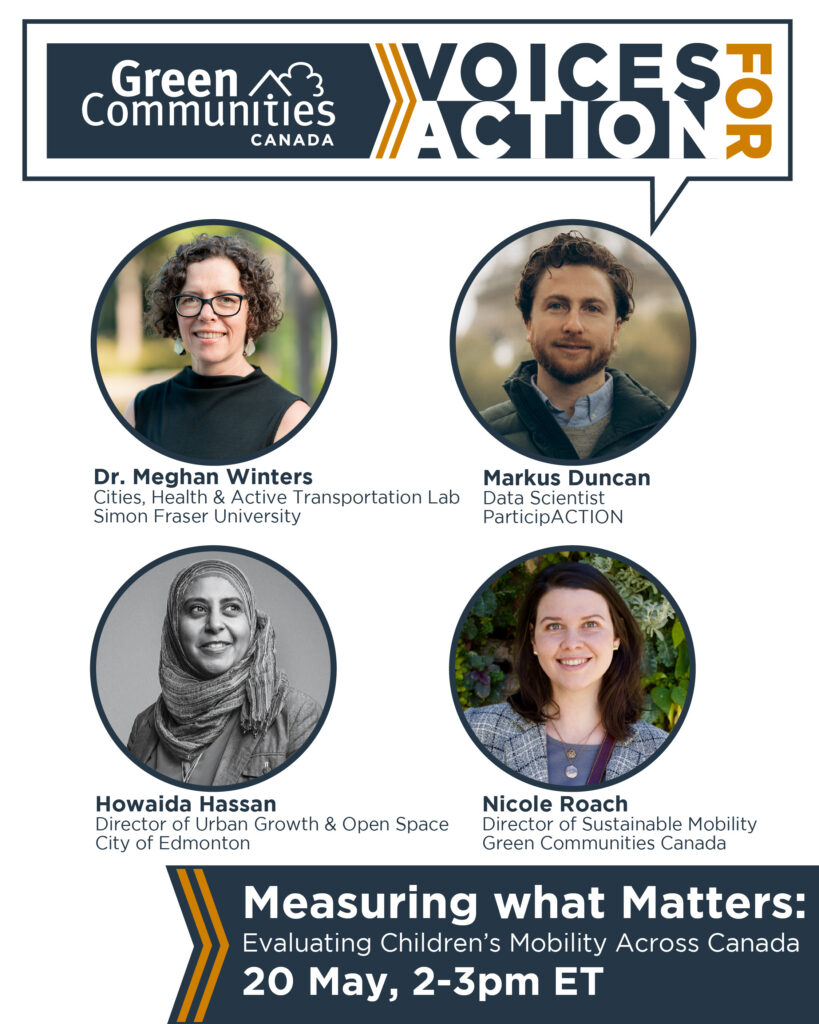
Panel Event on Evaluating Children’s Mobility Across Canada
On May 20 we are hosting a panel discussion about how we can better measure what matters when it comes to children travelling to school. Join Green Communities Canada and a panel of experts to discuss current evaluation practices, ongoing challenges, and the innovative work that is advancing research in this space.
Methods
Sustainable mobility professionals from Green Communities Canada, Urban Systems Ltd., and Simon Fraser University started with the Best Practices in School Data Collection in Canada report. The team used a combination of “hands-up surveys” and “family travel surveys” to collect data on student travel and barriers to active school travel. Teachers conduct the hands-up surveys (also known as student travel surveys) in their classrooms using the platform BikeWalkRoll. Parents and caregivers conduct the family travel surveys (also known as household travel surveys) online through SurveyMonkey.
More details are available in the “Methodology” section of the report on pages 8-13.
Key Findings
54 Ontario schools and 7 BC schools participated in the hands-up survey, capturing the data of 8,517 students at 61 schools. 235 families completed the family travel survey across both provinces.
Travel Mode Baseline
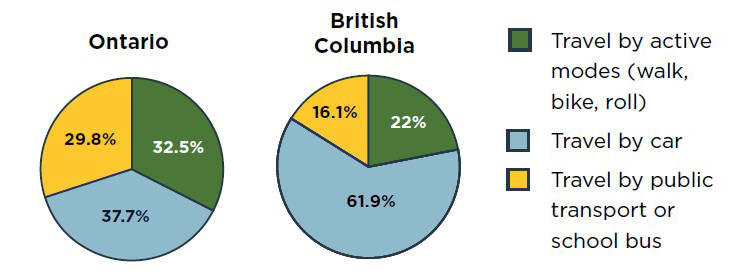
Across both provinces, the student travel survey results showed that travel by car was the most prevalent mode of travel to school. This car travel was far more pronounced in BC than in Ontario – 61.9% of BC students reported being driven to school compared to 37.7% of Ontario students. Travel by active modes was equivalent to travel by public transport or school bus. Travel rates varied widely between schools.
Pathways and Barriers to Active Travel
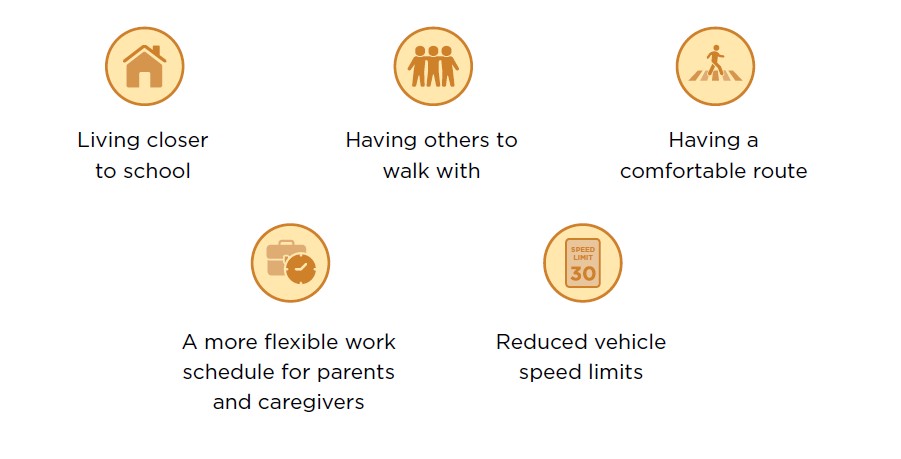
This survey asked parents and caregivers to select from a list of measures that would encourage their child to walk, bike, or roll to school. The most selected measures were as follows:
- if their child lived closer to the school,
- if their child had others to travel with,
- if there was a more comfortable route to school,
- if parents/caregivers had a more flexible work schedule, or
- if the route to school had safety measures like protected bike lanes, reduced vehicle speed limits, and traffic calming.
Recommendations
The following recommendations provide guidance on the who, what, when, and how, to help ensure the scalability and long-term success of future student travel evaluation initiatives:
- Government Leadership. Large-scale data collection initiatives related to student travel should be led by government bodies, ideally at the provincial level.
- Alignment with other Data Collection Initiatives. Governments should find alignment with other data collection initiatives—whether they be in classrooms, take-home surveys for parents and caregivers, or population-wide surveying.
- Collection at Regular Intervals. Data collection efforts should take place at a consistent interval. This timing should consider trade-offs between capturing the regular turnover in student grades while minimizing survey fatigue.
- Public Reporting on Findings. Governments should publish their research findings in a timely and accessible manner.
- Link to Mode Share Targets. Governments should embed mode share targets for student transportation into relevant strategies and actively monitor progress to continuously improve the effectiveness of interventions.
Complete details on each recommendation are available on pages 23-25 of the report.
Acknowledgements
This pilot was conducted with funding provided by the Government of Canada’s Active Transportation Fund, distributed by Housing, Infrastructure, and Communities Canada.
The Sustainable Mobility team at Green Communities Canada thanks the teams at Urban Systems Ltd. and the Cities, Health, and Active Transportation (CHATR) Lab at Simon Fraser University for their work as part of the project team. Please see page 1 of the report for full acknowledgements.
Resources
- Best Practices in School Data Collection in Canada Report
- Hands-Up Scotland Survey
- Transportation Tomorrow Survey
- Health Behaviour in School-Aged Children Study
- School Travel Planning by Student Transportation Services of Waterloo Region
- School Travel Planning by Green Communities Canada
- Active School Travel Program by City of Nanaimo
- Walk Pedal Ride Infographic
- 2024 Children and Youth Report Card by Participaction
- School Active Transportation in Canadian Children and Youth
- National Active Transportation Strategy