
Urban communities need to change. Across Canada and around the world, concrete jungles must incorporate purposeful greenspaces. Nature-based solutions can help reduce flooding, heat island effects, and poor air quality, while also boosting health and happiness.
But maintenance matters when it comes to the long-term services and benefits that these greenspaces provide. As we race to create more greenspace in the communities that need it most, we must re-think how we value, plan, and prioritize maintenance.
When we build new greenspaces, who is responsible for maintaining those spaces? What happens if they don’t? How are we supporting the monitoring and measuring the benefits of those greenspaces over time? What are the cost-benefit realities of maintaining greenspaces compared to costs for maintaining “grey” infrastructure solutions like stormwater drains?
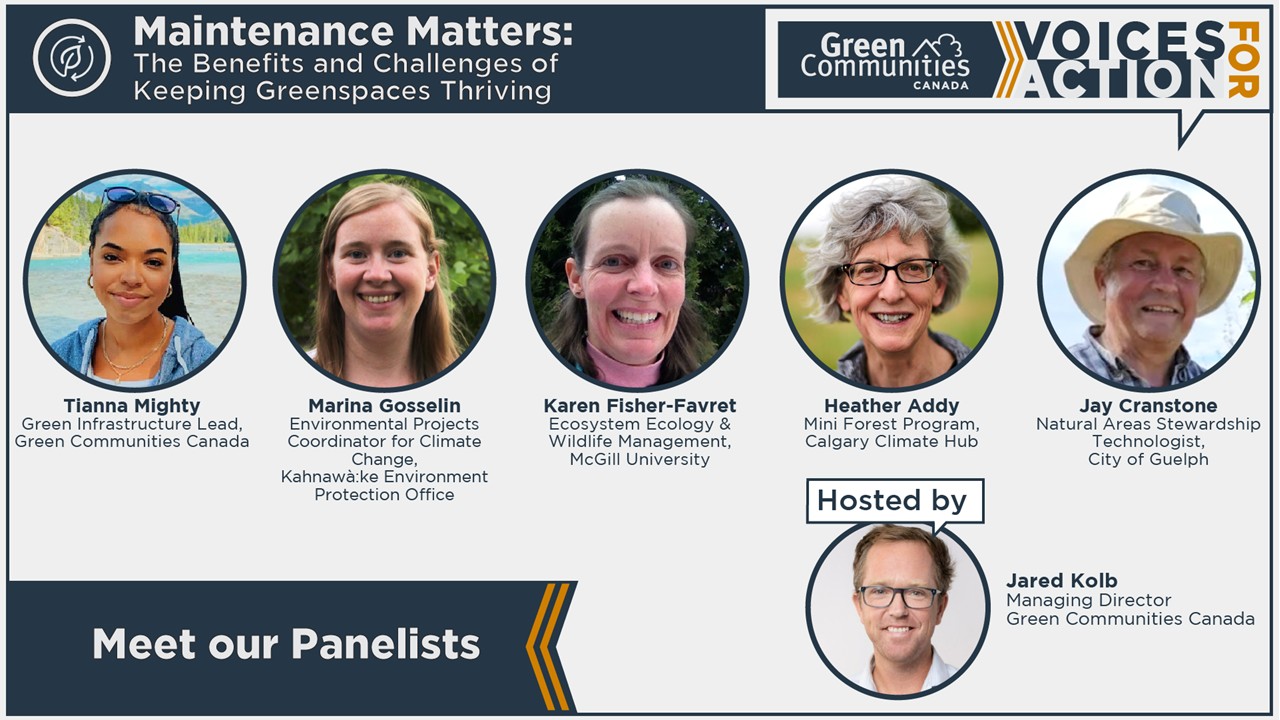
We convened a Voices for Action panel discussion on these themes. Here is the recording. Panelist bios and resource links are below.
Meet the Panelists:
Heather Addy (Calgary Climate Hub) – Heather Addy fell in love with plant biology in undergraduate field courses at the University of Alberta, where she earned a BSc in Botany and an MSc in Plant Ecology. Subsequent field work in the mountains & boreal forest with Alberta Environment and the University of Alberta sparked her interest in mycorrhizal associations, leading to a PhD in Soil-Plant Relations at the University of Guelph. After a career teaching plant & fungal biology at the University of Calgary, Heather retired in 2022. She now volunteers with the Calgary Climate Hub, where she co-leads the mini-forest planting program.
Jay Cranstone (City of Guelph) – Jay Cranstone is the Natural Areas Stewardship Technologist with the City of Guelph, Ontario. Jay has over 30 years of experience as a Landscape Architect, practicing an environmentally, socially, and culturally sustainable approach to creating spaces. Jay came to Guelph, Ontario, in 1987 to complete a Master’s Degree in Landscape Architecture at the University of Guelph. Following over 25 years in private sector consulting with local and international firms, Jay joined the City of Guelph Parks Operations team in 2019. He has been working to reach Guelph’s ambitious goal of achieving 40 per cent canopy cover and has coached many volunteers at planting projects supported by Green Communities Canada.
Karen Fisher-Favret (McGill University) – Karen Fisher Favret is an oceanographer currently teaching ecosystem ecology and fisheries and wildlife management at McGill (Macdonald campus) and co-ordinates the Finding Urban Nature (FUN) team at Concordia’s Science College. Karen holds a PhD in Biological Oceanography from Cornell University and an MSc in Biological Oceanography, Carbon Modelling, and Bio-physical Coupling from Dalhousie University. Her education and research experiences span University of California, Berkeley, Dalhousie University, Cornell University, and Los Alamos National Laboratory.
Marina Gosselin (Kahnawà:ke Environmental Protection Office) – Marina Gosselin has worked at the Kahnawà:ke Environment Protection Office for 5 years as the Environmental Projects Coordinator for Climate Change. In this role, Marina has worked on several planting projects that include a food forest, and planting trees to offset the impacts of the urban heat island effect using satellite images to determine the optimal planting sites in the community. Her work has included initiatives that raise awareness on climate change and its impacts on the community, as well as organizing workshops on climate change, ecological gardening and solar panel installation for cabins for community members. In 2025 she participated in the Leading Living Cities program of Green Communities Canada. She is currently working on a climate adaptation plan for Kahnawà:ke with the First Nations Adapt Program.
Tianna Mighty (Green Communities Canada) – Since 2022, Tianna has been working with Green Communities Canada in our Green Infrastructure team. Tianna has been leading new Living Cities Thriving Microgrant, which addresses a major gap in funding support for maintenance in the green infrastructure sector. She holds a BA in Environmental Science from the University of Manitoba, and has worked as the Climate Change Adaptation Assistant for the Rural Municipality of East St. Paul, and as a Biodiversity Researcher at Nature Canada.
Resources:
- Living Cities Canada Fund – Green Communities Canada
- GCC releases 2025 Living Cities Canada Fund Impact Report – Green Communities Canada
- Community stewardship – City of Guelph
- Calgary Climate Hub’s Forests for Calgary program.
- Aquatic Stewardship Program – KEPO
- Tekakwitha Island and Bay Restoration – KEPO
- Marlborough Tiny Forest – Calgary Climate Hub
- Green Communities Canada – Data Collection Workbook for maintaining Green Infrastructure